
Casino Gambling in Australia: Law, Access and Safety
 Available in AU
- Regulatory Landscape, Mobile Access and Player Safety in Australia
- Australian Casino Rankings – How Operators Compare
- Game Providers Operating in the Australian Market
- Pokies and Slots – Availability and Legal Status
- Live and Table Games – What Australian Players Can Access
- Bonuses and Promotions – Restrictions and Realities
- Payments and Withdrawals – Accepted Methods and Compliance
Regulatory Landscape, Mobile Access and Player Safety in Australia
Australian gambling law is not one system. It never was. There is no single overarching statute and no single gambling authority covering the country; regulation happens at two levels at once, Commonwealth and state/territory, and the seams between them show up every time someone tries to work out who is actually responsible for a given product.
At the federal level, the Interactive Gambling Act 2001 (IGA) is the primary Commonwealth law governing online gambling. Its stated purpose is public protection with a focus on harm minimisation, and that framing matters: it is not a licensing framework, it is a prohibition framework. Online casino-style games — pokies, poker, blackjack, roulette — cannot be offered to Australian residents, and no domestic licence for an online casino exists to apply for. Sports betting is different: it is legal online under state or territory licences.
A note on the record, because the sources disagree: some references cite an "Interactive Gambling Act 1997" as the law prohibiting online casino games for Australian residents, while the dominant and verifiable citation is the 2001 Act. I have never seen a 1997 Act operate in practice; everything enforced today runs through the IGA 2001. But the discrepancy exists in the literature and is worth naming rather than quietly resolving.
Who regulates what
Each Australian state and territory runs its own separate gambling regulator — Liquor & Gaming NSW, the Victorian Gambling and Casino Control Commission (VGCCC), the Office of Liquor and Gaming Regulation in Queensland, the Tasmanian Liquor and Gaming Commission, and their counterparts elsewhere. Land-based casinos answer to these state bodies and to law enforcement agencies, entirely separate from federal oversight of online gambling.

The Australian Communications and Media Authority (ACMA) is the federal regulator enforcing the IGA in the online space. The Northern Territory Racing Commission (NTRC) occupies an odd position: it licenses most of the national online bookmakers, who benefit from lower tax up there, which makes it something like the de-facto national online gambling regulator — for wagering, not for casinos.
The VGCCC adds a wrinkle worth knowing: it monitors all wagering service providers, including those based in other states, for compliance with the National Consumer Protection Framework. So a regulator in one state can be watching operators licensed in another. The system is fragmented, and the fragments overlap.
What ACMA can and cannot do
Since November 2019, ACMA has been able to order internet service providers to block illegal offshore gambling sites — typically online casinos, and sites offering online pokies or in-play online sports betting, none of which are permitted under Australian law.
The blocking numbers are genuinely contested in the sources. One figure has ACMA blocking 975 illegal gambling and affiliate websites as of a 2024 publication; another, per iclg.com, puts the count at 1,296 blocked sites and affiliates as of August 2025. On top of that, iclg.com reports over 220 services voluntarily exiting the Australian market — and boomaff.com separately claims more than 100 have exited since ACMA’s enforcement ramped up in 2017. These are reported figures from specific sources, not settled market data. What is not contested: the blocking program exists, it has grown, and it works through notices issued to ISPs.
ACMA’s other tools are less visible. It can instigate civil proceedings, notify border protection agencies about the directors and principals of offending offshore operators, and liaise with foreign regulators. It has served warning notices and referred matters to the Australian Federal Police where illegal gambling products were offered in Australia. It can even send letters to software developers and other third parties believed to be ancillary to an IGA contravention — going after the supply chain, not just the storefront.
ACMA cannot recover funds or settle individual disputes with offshore operators, so players have no recourse if a site refuses to honour withdrawals.
The limits matter as much as the powers. ACMA cannot recover funds or settle individual disputes with offshore operators. If a site takes your deposit and stonewalls your withdrawal, no Australian regulator will get that money back. ACMA also cannot force platforms like Facebook to block gambling advertisements targeting Australia, because of how the law words the prohibition on advertising "in Australia." Enforcement, in practice, is a game of whack-a-mole: sites get blocked, mirrors appear, the cycle continues.
The player-side picture
Here is the part most people get wrong. It is not illegal for an individual Australian to play at an offshore-licensed online casino. The IGA targets operators, not players. No one has been prosecuted for spinning online pokies from their lounge room. But the absence of player liability is not the same as protection: there are no domestically licensed real-money online casino operators, which means every casino site an Australian can reach sits outside every Australian consumer safeguard. No domestic complaint scheme, no ADR body with jurisdiction, no regulator that can compel a payout.
The practical consequences follow. Identity verification before withdrawal is something offshore operators impose on their own terms, not because an Australian authority requires it of them. Credit cards and digital currencies cannot lawfully be used for gambling payments in Australia — a restriction that belongs to the payments layer of the system, discussed in detail later in this article.
Safety mechanisms that do exist
For the legal products, the safety architecture is real. The National Self-Exclusion Register™, known as BetStop, lets a person exclude themselves from all licensed wagering operators at once. Gambling Help Online provides free support services nationally. Responsible-gambling messaging is mandatory in advertising, with harm-reduction information attached — the Betiquette campaign is the sector’s public-facing effort on that front.

The age gate is firm: the minimum legal gambling age in Australia is 18, and advertising cannot target minors, on television, in stadiums, or online. Those rules are enforced, however imperfectly, against the licensed wagering sector — the one part of the market that actually answers to an Australian regulator.
Mobile access sits awkwardly on top of all this. Nothing about the IGA changes because a site loads on a phone rather than a laptop. What changes on mobile is exposure: the same blocking regime applies at the ISP level, the same offshore operators advertise into Australian feeds, and the same ACMA limitation applies — it cannot require the platforms carrying those ads to stop. A mobile player navigating this market is doing so with the full fragmentation described above and none of the licensed-casino safety net that exists for betting customers.
That is the baseline everything else in this article builds on. Operators, game providers, bonuses, payments — each layer of the offshore casino market exists in the gap this regulatory structure leaves open.
A two-speed system. Legal wagering, unlicensed everything else.
Australian Casino Rankings – How Operators Compare
Choosing a casino means weighing licensing, welcome offers and how quickly you can access your winnings, so here’s a rundown of what each operator on this page brings to the table.
License: Curacao Gaming Control Board OGL/2023/174/0082 (Dama N.V.) · Bonus: up to A$5,000 + 300 free spins across 4 deposits Licensed under the Curacao Gaming Control Board, this operator backs its offering with a welcome package spread across four deposits, including a solid free spins allowance.
License: Curacao – Antillephone N.V. (Versus Odds B.V.) · Bonus: up to EUR 2,000 across 5 deposits + 200 free spins · Min. deposit: EUR 20 Operating under a Curacao (Antillephone) licence, it offers a multi-deposit welcome bonus with free spins and a clearly stated minimum deposit requirement.
License: Curacao eGaming (Dama N.V.) · Bonus: up to A$10,000 + 180 free spins, 40x wagering Holding a Curacao eGaming licence, this casino stands out for a sizeable welcome bonus paired with free spins, though the wagering requirement is on the higher side at 40x.
Bonus: up to A$7,500 + 550 free spins across 10 deposits, 50x wagering · Payout speed: crypto under 1 hour, PayID 1-3 business days · Min. deposit: A$20 (A$30 to qualify for the bonus) Notable for a generous welcome package spread over ten deposits with free spins, plus fast payout options including near-instant crypto withdrawals and quick PayID processing.
License: Curacao Gaming Authority (Jumpman Gaming Ltd) · Bonus: up to A$6,600 + up to 250 free spins across 4 deposits Licensed via the Curacao Gaming Authority under Jumpman Gaming, it offers a well-rounded welcome bonus with free spins across multiple deposits.
License: Curacao eGaming (Roby Games Ltd) · Bonus: 100% up to A$750 + 200 free spins Under a Curacao eGaming licence, this casino provides a straightforward welcome bonus matched with a decent free spins allowance.
Bonus: 240% up to A$4,100 + 300 free spins Distinguished by a high-percentage welcome bonus combined with a generous number of free spins.
License: international iGaming licence – jurisdiction not named in the source · Bonus: 100% up to A$1,000 + 100 free spins, 35x wagering · Payout speed: PayID 1-24 hours · Min. deposit: A$30 (PayID from A$10) Operates under an international iGaming licence and offers a welcome bonus with free spins, backed by notably fast PayID withdrawal times and an accessible minimum deposit.
License: Curacao eGaming (Hollycorn N.V., since 2017) · Bonus: 225% up to A$1,540 + 600 free spins across 4 deposits, 20x wagering · Min. deposit: A$20-30 (depends on the offer) Licensed by Curacao eGaming since 2017 through an established operator, it offers one of the larger welcome packages here with free spins across several deposits and comparatively low wagering requirements.
License: Curacao Gaming Control Board · Bonus: up to A$5,000 + 400 free spins Licensed under the Curacao Gaming Control Board, this casino rounds out the list with a solid welcome bonus and free spins offer.
Every "top 10 casino" list aimed at Australian players has one structural problem it never mentions: there is no such thing as a licensed online casino for Australians. There are no domestically licensed real-money operators, and it is not possible to obtain a licence to run one domestically. That is not an opinion about the market — it is the legal baseline. Everything a ranking promises to compare sits on top of that fact, and most rankings quietly build around it rather than on it.
I’ve been on the side that writes those lists. So here is how they are actually made.
What a ranking of offshore sites really ranks
When an affiliate site publishes a comparison of casinos "available to Australian players," it is comparing offshore operators licensed in other jurisdictions. The sites themselves are legal to play at — the Interactive Gambling Act 2001 targets operators, not individual players — but no Australian regulator vouches for any of them. No licence to check, no register to look up, no complaints body with teeth. The "ranking" is therefore not a regulatory assessment. It is a commercial arrangement dressed up as one.
The economics are simple. Affiliate commissions are paid for referred players. A site that appears first on a list is not necessarily the best operator; it is often the one paying the best commission at the time the list was updated. I have watched the same operator slide from first to fifth place, not because its service changed, but because its payout terms did. The list reordered itself overnight. Nothing about the player experience had moved.
"Independently reviewed" — in quotes, always. In most cases the reviewer holds an account with a referral link attached.
The criteria that sound meaningful
Typical ranking categories are compliance, game variety and user experience. It is worth taking each apart.
Compliance. For a site operating outside the Australian framework, this usually means the operator holds some offshore licence. Fine as far as it goes — but no offshore licence gives an Australian player recourse. The ACMA can investigate and block prohibited interactive gambling services, but it cannot recover funds or settle individual disputes with offshore operators. A ranking column headed "safety" is measuring something a regulator does not stand behind. If a dispute goes wrong, the licence that looked so reassuring in the footer is a long way away.
Game variety. This is the one criterion that can be checked, at least superficially. Which providers power the lobby, how broad the pokies selection is, whether live tables run at hours that suit Australian time zones. It is still self-reported by the ranking site, and lobbies change, but a game count is at least falsifiable in a way a "trust score" is not.
User experience. Loading speed, mobile layout, payment friction. Real properties, real differences between operators. Also the easiest thing to pad a review with when the substance is thin. Five paragraphs about a mobile app design and two sentences about withdrawal handling is a tell: the writer is avoiding the part they cannot verify.
What no ranking will tell you
Three things that matter more than position on a list:
-
Blocking risk. ACMA has been ordering internet service providers to block illegal offshore gambling sites since November 2019, and offshore casinos are the typical target. A site ranked first this year can simply stop resolving next year. No “updated for 2026” badge predicts that, because ACMA does not announce its blocking schedule to affiliates in advance.
-
Withdrawal reality. Deposits at every offshore operator are frictionless. That is not a feature; it is the business model. The information that matters is what happens on the way out — verification demands, delays, silent account reviews. Rankings rarely test this, because testing it costs money the affiliate does not get back.
-
Who answers when something breaks. An offshore operator with a licence and no Australian-facing accountability is a different proposition from a domestically licensed bookmaker, where a regulator sits behind the product. Mixing the two categories into one “gambling ranking” — as some sites do — erases the most important distinction on the page.
How to read any casino comparison for Australians
Since a regulatory ranking is impossible, treat every list as a lead generator with useful appendices. The practical filter:
- Ignore the order. Positions are bought and sold.
- Ignore trust scores. There is nothing domestic behind them.
- Extract the checkable facts: which providers appear in the lobby, which payment methods are listed, whether wagering terms are stated plainly.
- Assume any bonus framing is marketing. The next section of this article covers what is actually restricted there.
A short, honest note on timing: rankings age badly in this market. Between ACMA blocking actions and operators exiting, a comparison written in January can be stale by mid-year. A site that does not date its reviews is not telling you when the information stopped being true.
The comparison that actually exists
If the goal is to compare gambling services against each other in a meaningful way, the only apples-to-apples comparison available to Australians is between licensed wagering operators — sports and race betting, licensed at state and territory level, where regulators exist and complaints land somewhere. Online casino services, by contrast, sit entirely outside that structure. Ranking them is like ranking cars that cannot be registered: interesting, arguable, and not something the road authority will help you with afterwards.
So compare, if you compare at all — but compare with the framing intact. The question is never "which casino ranks first." It is "first at what, according to whom, and paid for how." Answer those three, and the list reads very differently.

Game Providers Operating in the Australian Market
Talk about who makes the games and you get to the part of the industry most players never see. Operators rent a front end; the actual product — the pokies, the live dealer tables, the card games — comes from software studios. And in Australia, those studios sit in a peculiar legal position: the law that bans online casino games from being offered to residents applies to the supply chain, not just the shopfront.
The studios behind the catalogues
A handful of names dominate the global iGaming industry, and their titles turn up wherever offshore casino sites serve Australian players. Pragmatic Play is one of the most prolific, with a catalogue that spans online pokies and live dealer formats. Microgaming has been in the business longer than most operators have existed and is frequently credited with supplying some of the earliest online progressive jackpots. NetEnt built its reputation on visually elaborate pokies that became fixtures on European-licensed sites. Evolution Gaming effectively owns the live dealer category — when a site streams a roulette wheel or a blackjack table from a studio in Riga or Malta, the engine behind it is usually theirs.
None of the major game studios hold an Australian licence because such a licence does not exist; their games are offered only through offshore operators.
None of these studios holds an Australian licence, for the simple reason that no such licence exists. It is illegal to offer online casino gambling in Australia and it is not possible to obtain a licence to operate an online casino domestically. So the same titles that sit under strict supervision in Europe reach Australian players, when they do, through offshore operators licensed by bodies such as the Malta Gaming Authority, the UK Gambling Commission, the Curacao Gaming Control Board or the Kahnawake Gaming Commission. The provider ships the game once; the jurisdiction of the player is the operator’s problem.
Where the enforcement actually lands
This is the part worth understanding, because it explains the shape of the market. The Australian Communications and Media Authority (ACMA) is the federal regulator that enforces the Interactive Gambling Act 2001, and its powers extend past the gambling sites themselves. ACMA can issue letters to software developers and other third parties believed ancillary to a contravention of the IGA. In practice, that means a studio whose games are prominently integrated into a site ACMA is targeting can expect contact — not prosecution, necessarily, but a warning that its distribution agreements are drawing attention.
Those letters work. Studios that want to keep their European licences tend to be sensitive about being named in Australian enforcement actions, and several have cut off aggregators or operators who refused to geo-block Australian traffic. The result is a market where availability is patchy and quietly negotiated rather than openly declared — a provider’s catalogue may be fully visible one quarter and partially withdrawn the next, depending on who has been served papers.
ACMA also has power to instigate civil proceedings, to notify border protection agencies of directors and principals of offending offshore operators, and to liaise with foreign regulators. That last lever matters more for game suppliers than it might appear: a studio incorporated in Europe or Malta answers to its home regulator, and a complaint passed between regulators carries more weight than a notice from a foreign authority that technically has no reach. When ACMA has found illegal gambling products offered in Australia, it has demonstrated it will serve warning notices and refer matters to the Australian Federal Police — and the mere existence of that referral pathway changes commercial behaviour upstream.

Regulated supply, unregulated distribution
There is a useful distinction here that most coverage of the Australian market blurs. Game providers themselves are, by and large, heavily regulated companies. Microgaming, NetEnt and Pragmatic Play content is certified and audited for the markets where it is legally sold, and Evolution Gaming operates licensed studios under European oversight. The certification travels with the game. What does not travel is accountability to the Australian player: ACMA can investigate and block prohibited interactive gambling services, but it cannot recover funds or settle individual disputes with offshore operators. If a certified game runs on an uncertified site and something goes wrong with the withdrawal, the studio’s licence is no comfort to anyone.
This is why the operator rankings and the provider picture have to be read separately. A site can list prestigious studio names — and most do, because the logos are free marketing — while the operator behind it answers to nobody ACMA can reach. The logo says the game engine is fair in the technical sense. It says nothing about the house around it.
The bookmaking side of the fence
Not everything in Australian interactive gaming runs through this grey channel. Online sports betting is legal in Australia under state and territory licences, and that segment has its own supply ecosystem — odds feeds, platform providers, wagering software — operating openly under Australian supervision. The Northern Territory Racing Commission (NTRC) functions as Australia’s de-facto online gambling regulator precisely because it licenses most national online bookmakers, who benefit from lower tax than they would face elsewhere. The same studios that power pokies for offshore sites also supply sportsbook platforms to bookmakers fully visible to and regulated by Australian authorities. The industry is not shy about gambling, per se. It is casino-style product, targeted at residents, that the IGA rules out.
What this means in practice
For anyone weighing up a site’s game library, the practical takeaway is narrow but real. The provider names on a landing page are genuine signals of one thing only — that the site has signed distribution deals with real studios. They are not signals of legality, since no legal route exists for that product in Australia, and they are not signals of recourse, since the regulator’s powers stop at blocking and enforcement. And the patchiness itself is informative: catalogues that shrink and swell, or studios that appear under unfamiliar aggregator brands, usually reflect someone’s response to an ACMA letter rather than a commercial strategy.
The games are well made. The machinery behind them is regulated — just not here, and not for you. That’s the whole picture.
Pokies and Slots – Availability and Legal Status
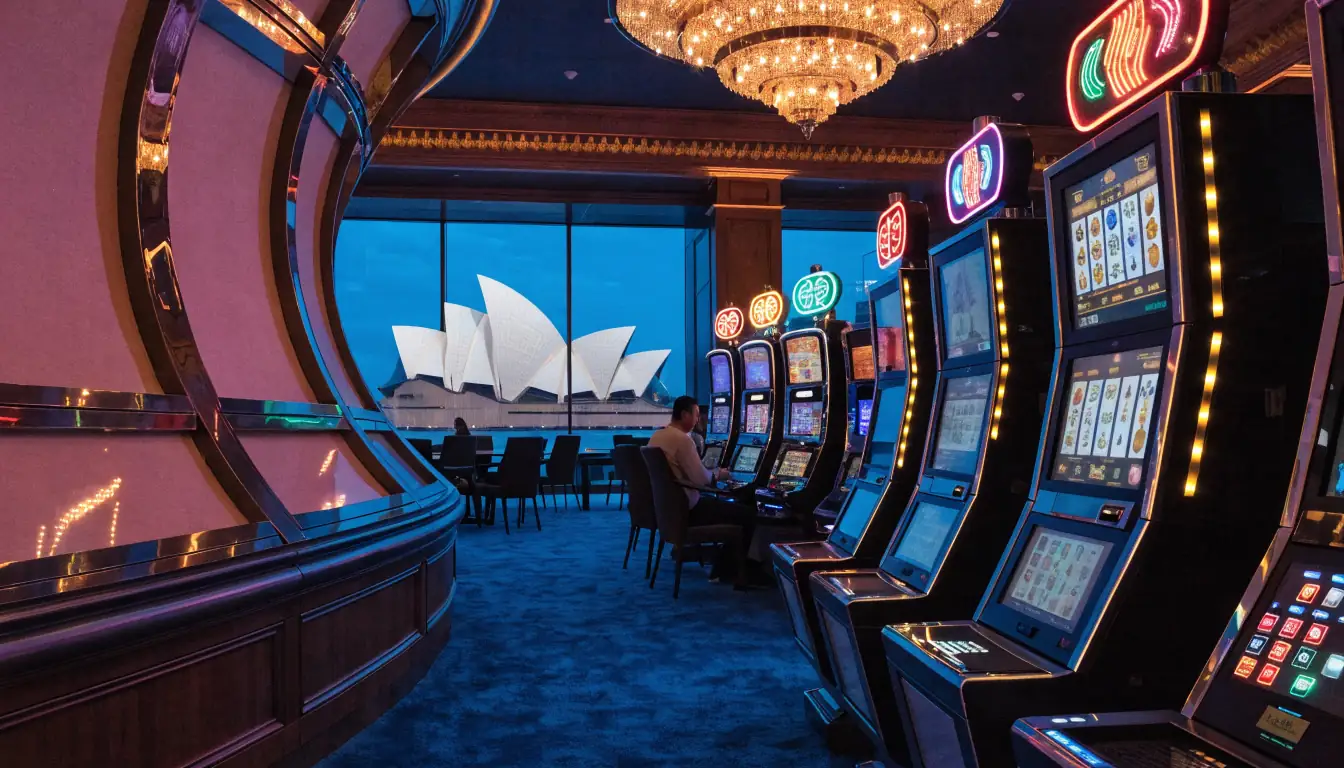
Walk into any pub or club in Australia and the pokies are there — rows of machines with their lights on, legal and regulated at the state level. Open a browser and look for the same games online, and the situation inverts completely. The machine in the venue is lawful. The same game on a website, offered to an Australian resident, is not.
That asymmetry is the single most important thing to understand about pokies in this country, and it’s worth taking apart carefully, because most of the confusion people have about "online pokies" comes from never quite grasping which side of the line they’re standing on.
What the Interactive Gambling Act actually prohibits
The Interactive Gambling Act 2001 (IGA) is the Commonwealth statute that governs interactive gaming, and it prohibits the provision of online casino-style games to Australian residents. Slots — pokies — sit squarely inside that definition. The same prohibition covers online poker, blackjack and roulette. The ban is federal, which means it applies across every state and territory, on top of whatever local rules each jurisdiction has for land-based venues.

There is a recurring point of confusion worth addressing directly: some sources describe the prohibition as coming from the Interactive Gambling Act 1997, others from the 2001 Act. The sources genuinely diverge on this. The 2001 Act is the one cited consistently as the operative Commonwealth law for online gambling, and it is the statute the Australian Communications and Media Authority (ACMA) enforces. I mention the discrepancy because anyone researching this topic will run into both dates, and silently picking one hides the problem rather than solving it.
The second point people get wrong, and get wrong confidently: the law targets the provider, not the player. Offering online pokies to Australians is illegal. Playing them at an offshore-licensed site, as an individual, is not a criminal offence. That distinction shapes the entire market — it’s why offshore operators have historically served Australian players at all, and why enforcement has focused on blocking and pressure rather than prosecution of individuals.
No licence means no licensed product
There is no pathway to a domestic online pokies licence in Australia. It is not that the licence is hard to get or expensive — it does not exist. No regulator in any state or territory can issue one, because online casino gambling sits in the prohibited category federally. This has a practical consequence that surfaces in almost every conversation about "choosing a safe site": there are no domestically licensed real-money online pokies operators. None. A website claiming an Australian licence for online pokies is either describing something else or misdescribing itself.

What does exist legally, in the interactive gaming space, is wagering. Online sports betting operates under state and territory licences. Pokies do not. So the phrase "legal online pokies in Australia" has no referent in the domestic market — the legal online product is a bet on a race or a match, not a spin of a reel.
Land-based pokies are a different story entirely. They’re regulated by state regulators and law enforcement agencies — the Victorian Gambling and Casino Control Commission, Liquor & Gaming NSW, the Office of Liquor and Gaming Regulation in Queensland, the Tasmanian Liquor and Gaming Commission — each under its own scheme. The machine in the club and the game in the browser may look like the same product, wear the same branding, even carry the same title. Legally, they belong to different worlds.
Where the games actually sit
The practical picture for anyone looking at online pokies from Australia:
- The offer is offshore by definition. Any real-money pokies site accessible here operates on a foreign licence — Malta, the UK, Curaçao, Kahnawake. None of those licences means anything to ACMA, and none of them grants permission to serve Australians.
- The enforcement tool is blocking. Since November 2019, ACMA has been ordering internet service providers to block illegal gambling sites, and online casinos are the typical target. The published totals vary by date and source: figures cited in 2024 put blocked sites and affiliates at 975, while figures from August 2025 put the number at 1,296, with over 220 services reported to have exited the market voluntarily. The two counts come from different reporting periods and different sources; the direction — steadily more blocks, steadily fewer operators willing to stay — is consistent even where the exact figure is not.
- Players are not the target. ACMA investigates and blocks prohibited interactive gambling services; it does not pursue the individuals using them. It also cannot recover funds or settle disputes with offshore operators — a point anyone depositing offshore should weigh without illusions.
One more thing the regulator cannot do: it has no power to require social platforms to block gambling advertising aimed at Australia, because of how the law’s advertising prohibition is worded. That gap is part of why offshore pokies brands stay visible to Australian audiences even as their websites get blocked. Enforcement is real, but it is partial by design — or at least by drafting.
"Free" pokies and other careful wording
There’s a category worth flagging because it trades on the ambiguity: social casino games and free-play pokies, where the reels spin and the wins accumulate but the currency is virtual. Played strictly for entertainment, these don’t fall under the IGA’s real-money prohibition. But the moment real money can be won or withdrawn, the product crosses into territory the Act and Australia’s virtual-currency rules do not permit. The line is the money, not the graphics. A site that blurs it is not being playful; it is being strategic.
Illegal Online Pokies
Offering real‑money online pokies to Australian residents is prohibited under the Interactive Gambling Act 2001 and can result in site blocking.
The honest summary
Legal pokies in Australia are the ones in the venue, regulated by the state. Online pokies offered to Australians are prohibited federally, cannot be licensed domestically, and exist only through offshore operators under ACMA’s blocking regime. The individual player commits no offence. That is the whole architecture, and every claim to the contrary — licensed online pokies, government-approved sites, "now legal in Australia" — is marketing wearing a costume.
The reels look the same on both sides of the line. The law does not.
Live and Table Games – What Australian Players Can Access
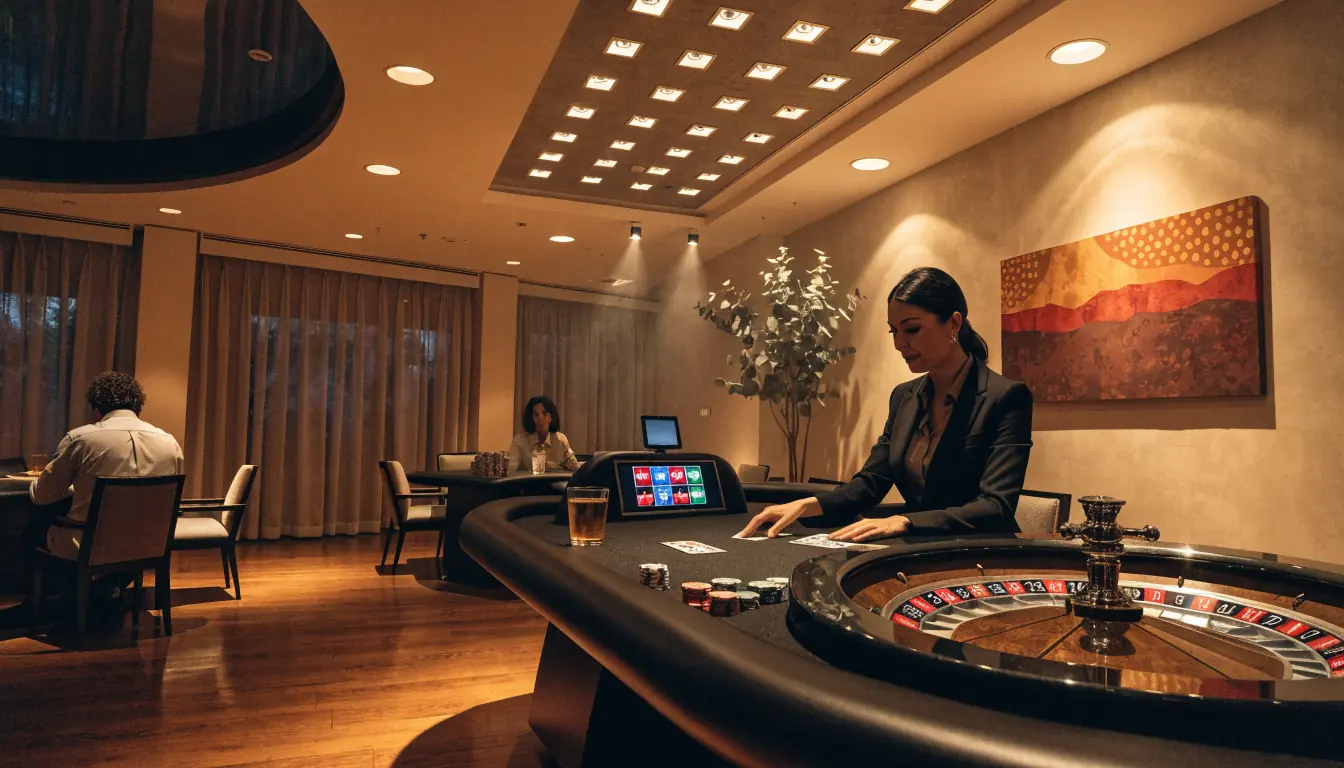
Walk through any casino floor in Melbourne or Sydney and the tables are the centrepiece: blackjack, roulette, baccarat, the poker rooms humming in the back. That’s the land-based picture, regulated by state bodies like the Victorian Gambling and Casino Control Commission and Liquor & Gaming NSW. Move that same table online, though, and the legal ground disappears beneath it.
The federal line
Online casino-style games — which explicitly includes blackjack and roulette, alongside poker — are prohibited under the Interactive Gambling Act 2001. One set of sources attributes this prohibition to an Interactive Gambling Act 1997 instead; the dates conflict, and I won’t paper over that. What the sources agree on is the substance: offering online casino games to Australian residents is illegal, and there is no domestic licence an operator could hold to do it lawfully. The law targets the provider, not the player, so an individual Australian sitting at an offshore-licensed table isn’t the one committing an offence. But "not illegal to play" and "protected while playing" are different things, and the second doesn’t follow from the first.
This is the line I watched people trip over constantly: the assumption that if a site takes their money, someone must have licensed it. No. There are no domestically licensed real-money online casino operators available to Australian players. Whatever table a player joins online is running under a licence issued somewhere else — Malta, Curaçao, Kahnawake — by a regulator with no obligation to an Australian resident.

What "live" actually means here, and the in-play distinction
The word "live" does double duty in this market, and untangling the two is the most useful thing a section on table games can do.
Live dealer casino games — streamed tables with a human croupier, roulette wheels spun in real time, blackjack dealt from a shoe. These fall squarely inside the casino-style prohibition. An operator offering them to Australians is contravening the Act, and the Australian Communications and Media Authority (ACMA) can request that such sites be blocked.
Live (in-play) sports betting — betting on a match after it has started. Also prohibited online, federally. But here’s the twist that catches even fairly savvy punters: live betting by phone is legal. The same wager, placed over a voice call with a licensed bookmaker, is fine. The restriction is about the online channel, not the bet itself. So a punter watching the footy who wants a live bet mid-match picks up the phone rather than tapping an app — an artefact of how the legislation was drafted, and a strange one.
That phone-call carve-out is worth sitting with for a second, because it explains the whole shape of the market. Australian law doesn’t sort gambling into "allowed" and "banned" by product alone. It sorts by product and channel and who holds the licence. Online sports betting under a state or territory licence: legal. In-play betting online: prohibited. In-play by phone with that same licensed bookmaker: legal. Live dealer roulette online: prohibited, full stop, because there’s no licence category for it to live in.
What remains genuinely accessible
Strip away what’s prohibited and the legal live-and-table offering for an Australian is narrow but real:
- Land-based casino tables — blackjack, roulette, baccarat, poker — at casinos regulated by state regulators and law enforcement agencies, entirely separate from ACMA’s patch. Minimum age of 18, enforced at the door.
- Telephone in-play betting with licensed bookmakers, most of whom operate under Northern Territory Racing Commission licences.
- Online sports wagering pre-match, under the same state/territory licensing arrangements.
That’s the lawful list for live and table play. Everything else advertised at Australians — streamed roulette, live blackjack tables, online poker rooms — sits on the prohibited side, which is precisely why ACMA issues blocking notices to internet service providers for sites carrying those games. The block list isn’t theoretical. Sources disagree on the cumulative count: one figure cited for August 2025 is 1,296 illegal gambling sites and affiliates blocked since 2019, while an earlier publication put the number at 975 — treat either as a snapshot from a given source, not a settled market figure. The trend, not the number, is the point: enforcement keeps expanding.
The gap the offshore tables fill — and what they don’t fill
None of this has stopped the tables from existing for Australian players. Offshore operators still deal them, and individuals still sit down. The consequences of that arrangement land unevenly.
ACMA can investigate and block prohibited interactive gambling services, initiate civil proceedings, notify border protection agencies about the directors of offending operators, and liaise with foreign regulators. What ACMA cannot do is recover funds or settle individual disputes with offshore operators. Sit down at a streamed blackjack table, have a payout go wrong, and there is no Australian body with the power to reach into that dispute. The regulator that licensed the site answers to its own jurisdiction, not to a resident of Adelaide.

That asymmetry — the player exposed, the operator out of reach — is the practical meaning of a prohibition that targets providers rather than players. The law isn’t silent about the situation; it has simply decided whose problem it is.
A short accounting
Legal table games for Australians: the ones on physical floors, plus phone-based live betting with licensed bookies. Everything streamed, everything with a virtual felt, exists here in a grey that isn’t grey at all for the operator — it’s black-letter prohibited, just enforced through blocking and market exit rather than prosecution of players. The honest summary of "what Australian players can access" online in live dealer tables is: nothing anyone is permitted to deal them. The tables that take them anyway aren’t hidden from the law. They’re hidden from help.
Bonuses and Promotions – Restrictions and Realities
There is a strange asymmetry in the Australian market when it comes to bonuses. On one side sits the law, which draws a hard line around anything that looks like an inducement. On the other sits the offshore sector, which advertises with almost no regard for that line at all. Anyone comparing what Australian players are offered with what they are legally supposed to see will notice the gap immediately, and that gap is the whole story of this section.

Where the rules come from
The starting point is the Interactive Gambling Act 2001. Online casino games — pokies, poker, blackjack, roulette — cannot be lawfully offered to Australian residents at all, which means there is no such thing as a licensed, domestically regulated casino bonus in this country. No regulator approves a welcome package here, because no regulator can approve the product it attaches to. The IGA’s stated purpose is harm minimisation, and the restrictions on inducements follow from that logic: a bonus is, by definition, a mechanism that encourages someone to start or keep playing.
The same principle extends to advertising. Inducements to open a betting account are prohibited under the advertising codes, and the phrase "welcome bonus" itself belongs to a category of messaging that licensed Australian wagering operators are not permitted to use. So when an Australian sees a "welcome bonus" from an online casino, the offer is coming from a service that is operating outside the Australian framework entirely.
State and territory regulators — the Victorian Gambling and Casino Control Commission, Liquor & Gaming NSW, and their counterparts — do monitor wagering service providers for compliance with the National Consumer Protection Framework, including its rules on inducements. But their power stops at the water’s edge. They, like ACMA at the federal level, have limited reach over offshore online casinos. An offshore operator that ignores Australian advertising rules faces blocking of its website, not a fine handed down in a Melbourne courtroom. Enforcement is real, but it is indirect.

Wagering requirements — the part the banner never explains
Since there is no Australian licensing regime for online casinos, the terms attached to offshore promotions are written under someone else’s rules. That "someone else" might be the Malta Gaming Authority, the UK Gambling Commission, the Curacao Gaming Control Board or the Kahnawake Gaming Commission — jurisdictions with very different attitudes toward what a fair bonus term looks like.
The mechanics are broadly familiar. A bonus comes with wagering requirements: the condition that a deposited amount, bonus amount, or both must be staked a set number of times before any winnings can be withdrawn. What varies — wildly — is the disclosure. Under some regulatory regimes, operators are required to display wagering requirements clearly and up front, before the bonus is accepted. Under others, the multiplier sits in a terms page nobody reads until a withdrawal is frozen.
From inside the industry, the honest description of a wagering requirement is this: it is a retention tool dressed as a gift. The bonus gives the player more time on the pokies; the requirement makes sure that time is spent on the operator’s platform and not withdrawn early. "Free" in this context means "paid for with your patience."
Bonus disputes with offshore casinos are not covered by any Australian regulator, leaving players without a formal avenue for complaint.
Why "restricted" is the wrong word — "unsanctioned" is more accurate
The practical reality for Australian players is not that bonuses are limited by Australian law. Australian law does not regulate these bonuses at all — it prohibits the underlying service. What limits the promotions is a combination of:
- Jurisdiction of the licence. Some offshore regulators restrict aggressive bonus marketing by their licensees; others impose essentially nothing.
- Payment friction. Since the prohibition on credit cards and digital currencies for gambling took effect in June 2024, offshore operators have had to adapt their deposit-based bonus structures to the methods Australian players can actually use. A bonus tied to a payment method that no longer works locally is a bonus that quietly disappears.
- ACMA enforcement. Affiliate sites that promote prohibited interactive gambling services are themselves subject to blocking. ACMA has been blocking not just gambling sites but their affiliates since late 2019, which thins out the layer of promotional pages that would otherwise funnel Australian traffic toward bonus offers.
That last point matters more than people assume. The bonus ecosystem runs on affiliates, and in Australia the affiliate layer is under direct regulatory attack. When the affiliates go, the promotion reaches fewer eyes.
Complaints, disputes and the limits of recourse
A bonus dispute — a refused withdrawal, a retroactively applied term, a "voided" win — is where the absence of an Australian licence becomes tangible. ACMA can investigate and block prohibited interactive gambling services, but it cannot recover funds or settle individual disputes with offshore operators. There is no Australian ombudsman for a bet placed with a Curacao-licensed site. The dispute provisions and ADR channels that a licensed market would provide simply do not exist for this product category.
What an Australian player should actually conclude
The realistic picture, stripped of marketing:
- Any casino bonus offered to an Australian is offered by an operator functioning outside Australian law.
- Wagering requirements are the norm, and their transparency depends entirely on which foreign regulator, if any, holds the operator to account.
- There is no domestic authority that will adjudicate a bonus gone wrong.
- Services offering these bonuses have been exiting and being blocked since ACMA’s enforcement regime began, meaning the shelf behind any given promotion can be shorter than its own terms.
None of this makes the bonuses disappear from view. They remain visible, persistent, and often well-produced. But visibility is not legitimacy, and in this market the two have never been the same thing.
Payments and Withdrawals – Accepted Methods and Compliance
Money is where the marketing stops. A bonus page can promise anything; the cashier is where the promise either clears or stalls. In Australia, the cashier is also where the law bites hardest — not through the operators, but through the pipes the money travels in.
What the law actually restricts
The Interactive Gambling Act 2001 makes it an offence to offer online casino games to Australians. It does not criminalise the individual who plays. That asymmetry, covered earlier in this article, shapes the whole payments picture: since there are no domestically licensed real-money online casino operators, every casino cashier an Australian player encounters sits offshore, and every transaction with it is a cross-border one by definition.

On the domestic side, the rules are firm. Credit cards cannot be used for gambling deposits — the ban on credit card deposits for wagering sits alongside the long-standing prohibition on interactive gambling products themselves. Digital currencies are in the same category: since June 2024, cryptocurrency deposits for gambling are off the table for services operating lawfully in the Australian market. Bitcoin and Ethereum appear in the cashier menus of offshore casino sites, and that presence itself is a signal — a compliant Australian wagering service would not offer them.
What remains for the licensed side of the market — the state and territory licensed bookmakers and wagering operators — are the ordinary rails: PayID, debit instruments, bank channels. PayID has become the local shorthand for fast Australian bank payments, and its dominance in the licensed wagering sector is no accident. It is domestic, traceable, and sits comfortably inside the compliance perimeter.
KYC is the gate, not the afterthought
The pattern I have seen hold true across every legitimate transaction chain is that identity verification happens at withdrawal, not deposit. That sequencing is not a technical limitation — it is a design choice. Deposits are frictionless because frictionless deposits maximise volume; KYC (Know Your Customer) requirements surface at cashout because that is when the operator’s obligations, and the regulator’s expectations, actually attach. Government-issued ID before any withdrawal is the standard, and on the licensed side it is not negotiable.
Offshore casino cashiers mimic the same structure — deposit in seconds, documents requested at payout — but without a domestic regulator standing behind the process. There is no ombudsman for a stalled offshore withdrawal. ACMA can investigate and block prohibited interactive gambling services, but it cannot recover funds or settle individual disputes with offshore operators. That single sentence is the most important one in this section for anyone moving money. A blocked site is an inconvenience; an unresolved withdrawal from one is a loss with no recourse.
Blocking orders affect not only casino sites but also their cash‑in pages, meaning payment routes can disappear without notice.
What blocking does to the money flow
ACMA has been ordering internet service providers to block illegal offshore gambling sites since November 2019. The numbers vary depending on who is counting and when. One published account puts the figure at 975 blocked gambling and affiliate websites as of 2024; a later report dated August 2025 cites 1,296 illegal sites and affiliates blocked since 2019, per iclg.com. The same sources diverge on voluntary exits — more than 100 services leaving the market per one account, over 220 per another. The discrepancy is the story: blocking enforcement is active, escalating, and nobody’s tally is final.
For payments specifically, blocking cuts two ways. First, the direct effect: a blocked domain takes its cashier with it. Balances do not disappear because a site is unreachable from Australian ISPs, but the practical route to them narrows to mirror domains and workarounds — exactly the channels where payment disputes go to die, because a mirror domain has no reputation to protect.
Second, the structural effect: ACMA can issue letters to software developers and other third parties believed to be ancillary to a contravention of the IGA. Payment processors sit squarely in that blast radius. The more than 100 services that, per theiaga.org, exited the Australian market after enforcement ramped up in 2017 did not leave because Australians stopped playing. They left because staying became commercially and legally expensive — and the cost lands hardest on the financial infrastructure a site depends on.

The advertising gap
One more compliance detail that touches payments indirectly: ACMA has no power to require platforms like Facebook to block gambling advertisements targeting Australia, because the law prohibits advertising "in Australia" — and the wording has not kept pace with how ad targeting actually works. The practical consequence is that promotional pressure keeps flowing toward offshore casino brands through channels the regulator cannot reach, even while the regulator can and does block the cashier pages those promotions lead to. The money arrives at a door the regulator is actively closing.
Moving money with open eyes
None of this makes offshore transactions impossible. It makes them one-directional in trust: an Australian player can send money to an offshore casino easily and get it back only at the operator’s discretion, with no Australian authority empowered to intervene. KYC still applies — offshore operators verify identity too, for their own licensing reasons under regulators like the Malta Gaming Authority or the Curacao Gaming Control Board — but verification by a distant regulator protects that regulator’s licence, not the player’s balance.
The licensed side is the mirror image: fewer product options, no casino games at all, but every payment backed by a domestic licence, enforceable complaint procedures, and a regulator that answers to someone. For wagering, that trade is worth making. For casino play, the trade does not exist domestically — which is precisely why the offshore cashier, with all its friction and all its silence at withdrawal time, remains the only one on offer.
Created by the ”Casino Mobile Guide” editorial team.